
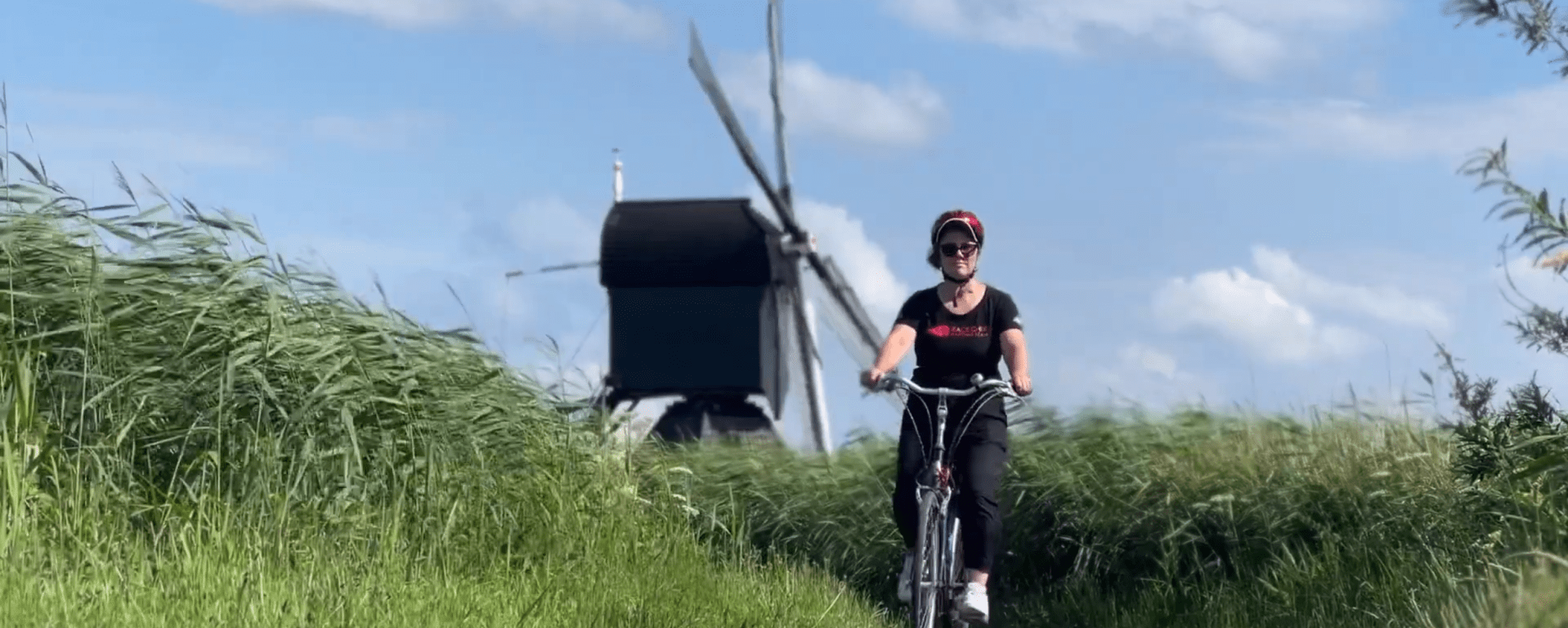
I’m about to do the most stereotypical thing imaginable in the Netherlands — ride a bike to see some windmills. But what I didn’t expect was to come away genuinely fascinated, a little bit awestruck, and suddenly very aware that these beautiful old structures are the reason entire communities are still standing today.
I came to Kinderdijk because it’s a UNESCO World Heritage Site, and because, frankly, it looked gorgeous in the photos. And it is. But I also ended up spending three days here learning far more than I ever thought I would about water management, clever engineering, and just how precarious life in the Netherlands actually is.
These windmills aren’t just decorative relics from the 1700s — they are part of a system that has meant the difference between dry land and drowning for centuries. Some of them still operate. Some are still lived in. And all of them tell a story about human ingenuity, stubbornness, and the determination to live in a place that really doesn’t want to cooperate.
Windmills, it turns out, are very cool.
🎥 Watch the Video
If you prefer watching rather than reading, the full video is here.
🗺️ What This Video Covers
- Cycling to the Kinderdijk windmills in the Netherlands
- Why Kinderdijk is a UNESCO World Heritage Site
- How windmills actually work (and why they still matter)
- Life inside a working mill
- The constant battle against water in the Netherlands
- One very unexpected museum visit (and cheese tasting)
📍 The Story Behind the Scenes
Standing among the windmills at Kinderdijk, it’s easy to focus on how beautiful they are — the reflections in the water, the perfectly flat landscape, the sense that you’ve cycled straight into a painting. But once you start learning why they’re here, the whole place takes on a much deeper meaning.
The Netherlands quite literally means “the lower countries,” and for good reason. Around 26% of the country sits below sea level, and nearly 60% would flood if there were a major storm or rising sea levels. As one local explained it very plainly: we live six feet below sea level — if we don’t pump water away, we drown.
The land here was reclaimed over centuries. Trenches were dug so water could drain into channels, peat dried to create usable land, and dykes were built to protect everything from the North Sea. In the 14th century, two enormous canals were hand-dug to move water toward the lowest point, where sluice gates could release it into nearby rivers when tides were low.
But by the 18th century, gravity alone wasn’t enough. The difference in water levels wasn’t sufficient to drain the land safely — so they built windmills. Twenty of them at Kinderdijk, designed to pump water continuously and efficiently. Working together, they could move the equivalent of an Olympic swimming pool of water at a time.
Some of these mills are still operational today as a backup system. Others are museums. And many are leased as private homes — with the small catch that you need to study for three years before you’re allowed to live in one. One family has been leasing their mill for eleven generations.
Inside the museum mill, I climbed through narrow staircases and tiny rooms, learning how families lived, worked, and slept in spaces that doubled as machines. Children slept together in an unheated attic for warmth. Animal skins were dried in smoky upper levels. Everything was functional, practical, and incredibly well thought out.
It’s clever engineering. It’s human resilience. And it’s far more fascinating than I ever expected.
🧠 Things I Learned
- Windmills aren’t decorative — they’re essential infrastructure
- Water management in the Netherlands is a constant balancing act
- These systems still operate as backups today
- Living in a windmill requires serious training and responsibility
- Clever engineering doesn’t have to be complicated to be brilliant
💬 Over to You
Had you ever thought about why the Netherlands has so many windmills — or were they just part of the scenery for you too?
Let me know in the comments — I read every one.
Discover more from Helen Wheels - Solo Female Van Life Adventures
Subscribe to get the latest posts sent to your email.
 Helen Wheels - Solo Female Van Life Adventures